
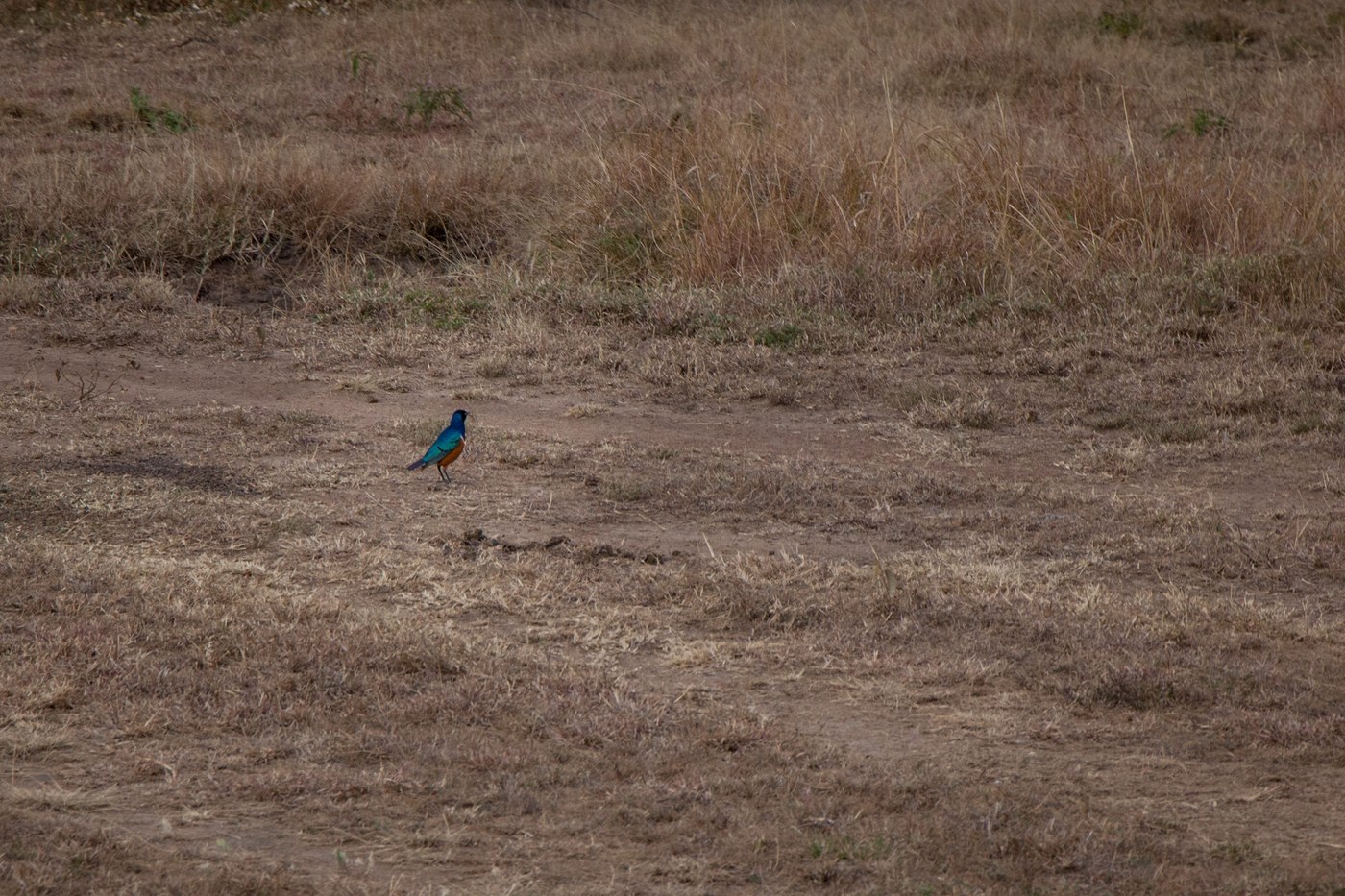
Superb Starling
Lamprotornis superbus
A dazzling East African songbird with glossy blue-green upperparts, a bold white breast band, and a warm chestnut-orange belly, common around towns and savanna.
- Feather type
- Glossy, iridescent body feathers with a sharp color-block pattern
- Colours
- Iridescent blue-green upperparts, chestnut-orange belly, white breast band
- Bird size
- Robin-sized, ~18 cm
Found a feather like this?
Identify any feather from a photo, free.
Overview
The Superb Starling is a brightly plumaged songbird native to open savanna and woodland of eastern Africa, notable for its glossy, multicolored plumage and its tolerance of human settlements, where it is a familiar and confiding visitor to gardens, lodges, and outdoor eating areas.
Identifying the Feather
Flight feathers: glossy metallic blue-green with a strong iridescent sheen visible in good light. Tail feathers: similarly glossy blue-green, relatively short and squared. Body feathers: the head, throat, and upper breast are glossy blue-green, sharply demarcated from a narrow white breast band, below which the belly and flanks are a warm chestnut-orange, and the eye is pale cream to white. This sharply divided color-block pattern, with a distinct white band separating the glossy upperparts from the chestnut underparts, is diagnostic and unlike any North American or European starling.
Plumage & Molt
Sexes look alike. Adults show glossy blue-green upperparts and upper breast, a crisp white breast band, chestnut-orange lower breast and belly, and a pale eye. Juveniles are duller, with a browner head and less defined breast band, gradually acquiring the bold adult pattern through post-juvenile molt. There is no strong seasonal plumage variation.
Habitat & Range
Superb Starlings are found across savanna, open woodland, and scrubland of eastern Africa, including Ethiopia, Kenya, Tanzania, and Uganda. The species is generally resident, though local movements may occur in response to food availability, and it readily adapts to human-modified landscapes.
Behavior & Field Notes
This starling forages on the ground and in low vegetation for insects, other invertebrates, and fruit, and often gathers in noisy, social flocks. It is a cooperative breeder, with helpers sometimes assisting a breeding pair at the nest, which is typically built in a tree cavity or dense shrub. Calls include a range of chattering, whistled, and grating notes, often given by groups foraging or perched together.
Frequently asked questions
What makes Superb Starling feathers so recognizable?
The sharp division between glossy blue-green upperparts and a warm chestnut-orange belly, separated by a crisp white breast band, is a distinctive pattern not found in North American or European starlings.
Do juvenile Superb Starlings show the same bright colors?
No, juveniles are duller and browner overall with a less defined white breast band, gaining the bold adult pattern gradually through molt.
Is the iridescence visible in all lighting?
The glossy blue-green sheen is most visible in direct light and can appear much duller or blackish in shade, a common feature of iridescent starling feathers generally.
Where would this species typically be encountered?
In savanna, open woodland, and scrubland across eastern Africa, and it is also a common, confiding visitor around towns, lodges, and gardens in the region.
Superb Starling guides
In-depth guides for identifying and understanding Superb Starling.
Superb Starling identified by the community
Real feathers identified with Feather Identifier.

Other feathers you may enjoy

Yellow-breasted Bunting
Contour and flight feathers, chestnut-and-yellow breeding pattern

Sedge Wren
Tiny streaked crown and back feathers

Yellow-winged Cacique
Glossy black body feathers, yellow wing patch, shaggy crest

Yellow Warbler
Small contour and flight feathers

Yellow-throated Warbler
Small contour and flight feathers

Yellow-throated Vireo
Bright yellow throat and spectacle feathers; olive-green back feathers; two white wing-bar feathers

Yellow-rumped Warbler
Small contour and flight feathers

Yellow-hooded Blackbird
Contrasting hood and body feathers

Yellow-headed Blackbird
Glossy black body plumage with a bright yellow head and breast

Yellow-eyed Junco
Contour and flight feathers

Yellow-fronted Canary
Small, smooth body plumage

Yellow-breasted Greenfinch
Compact, smooth body plumage