
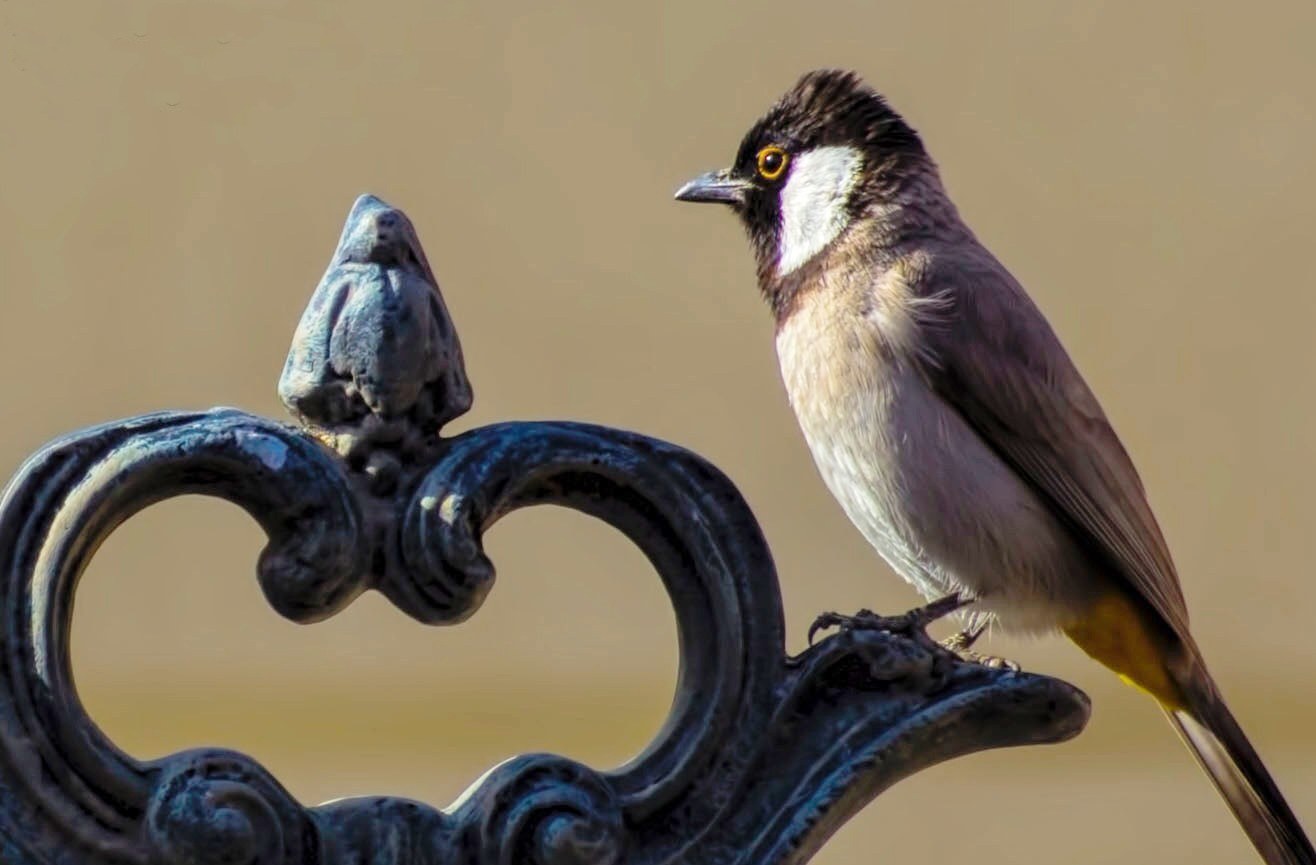
White-eared Bulbul
Pycnonotus leucotis
A dry-country bulbul with a black head, distinctive white ear patch, and bright yellow undertail, common around gardens and arid scrub.
- Feather type
- Soft contour feathers with a short crest
- Colours
- Brownish-grey body, black head, white ear patch, yellow vent
- Bird size
- Sparrow-to-robin-sized, ~20 cm
Found a feather like this?
Identify any feather from a photo, free.
Overview
Overview
The White-eared Bulbul is a songbird found across arid parts of the Middle East and South Asia, recognized by its black head, contrasting white patch behind the eye, and bright yellow patch under the tail. Its brownish-grey body plumage is relatively plain, making the facial and vent markings the most useful identification features.
Well adapted to dry habitats, this species is commonly found around oases, gardens, and scrubland, often near human settlements where water and food are available.
Identifying the Feather
Feather Identification
- Head feathers: black, extending down to cover the crown and upper nape
- Facial feathers: bold white patch behind and below the eye, a key distinguishing mark
- Body feathers: brownish-grey overall, relatively unpatterned compared to the head and vent
- Vent feathers: bright yellow, contrasting sharply with the duller body plumage
- The combination of black head, white ear patch, and yellow vent is diagnostic and separates this species clearly from other bulbuls in its range
Plumage & Molt
Plumage Notes
Adults of both sexes show similar plumage, with the black head, white ear patch, and yellow vent present year-round. Juveniles are duller with less defined head markings, gradually acquiring adult coloration.
Molt occurs annually, with gradual feather replacement that preserves flight ability throughout the year.
Habitat & Range
Habitat & Range
White-eared Bulbuls are found across arid and semi-arid regions of the Middle East, including the Arabian Peninsula, and into parts of South Asia. They favor oases, gardens, scrubland, and areas near human settlement.
The species is largely resident, well adapted to dry climates and dependent on locally available water sources and vegetation.
Behavior & Field Notes
Behavior & Field Notes
White-eared Bulbuls feed on fruit, nectar, and insects, often foraging in pairs or small groups in shrubs and trees. They are vocal and conspicuous, frequently seen around gardens and settled areas.
Nests are cup-shaped structures built in shrubs or trees, with both parents contributing to raising chicks. Their calls are bright, chattering whistles, commonly heard in gardens and scrubland habitats.
Frequently asked questions
What feather markings identify a White-eared Bulbul?
A black head, a bold white patch behind the eye, and a bright yellow vent patch together are the key identification features.
Where do White-eared Bulbuls typically live?
They inhabit arid and semi-arid regions of the Middle East and South Asia, often near oases, gardens, and human settlements.
Are male and female White-eared Bulbuls different in plumage?
No, the sexes look similar, with both showing the same black head, white ear patch, and yellow vent.
What does a White-eared Bulbul sound like?
It gives bright, chattering whistled calls, commonly heard around gardens and scrubland.
White-eared Bulbul guides
In-depth guides for identifying and understanding White-eared Bulbul.
Other feathers you may enjoy

Yellow-breasted Bunting
Contour and flight feathers, chestnut-and-yellow breeding pattern

Sedge Wren
Tiny streaked crown and back feathers

Yellow-winged Cacique
Glossy black body feathers, yellow wing patch, shaggy crest

Yellow Warbler
Small contour and flight feathers

Yellow-throated Warbler
Small contour and flight feathers

Yellow-throated Vireo
Bright yellow throat and spectacle feathers; olive-green back feathers; two white wing-bar feathers

Yellow-rumped Warbler
Small contour and flight feathers

Yellow-hooded Blackbird
Contrasting hood and body feathers

Yellow-headed Blackbird
Glossy black body plumage with a bright yellow head and breast

Yellow-eyed Junco
Contour and flight feathers

Yellow-fronted Canary
Small, smooth body plumage

Yellow-breasted Greenfinch
Compact, smooth body plumage