
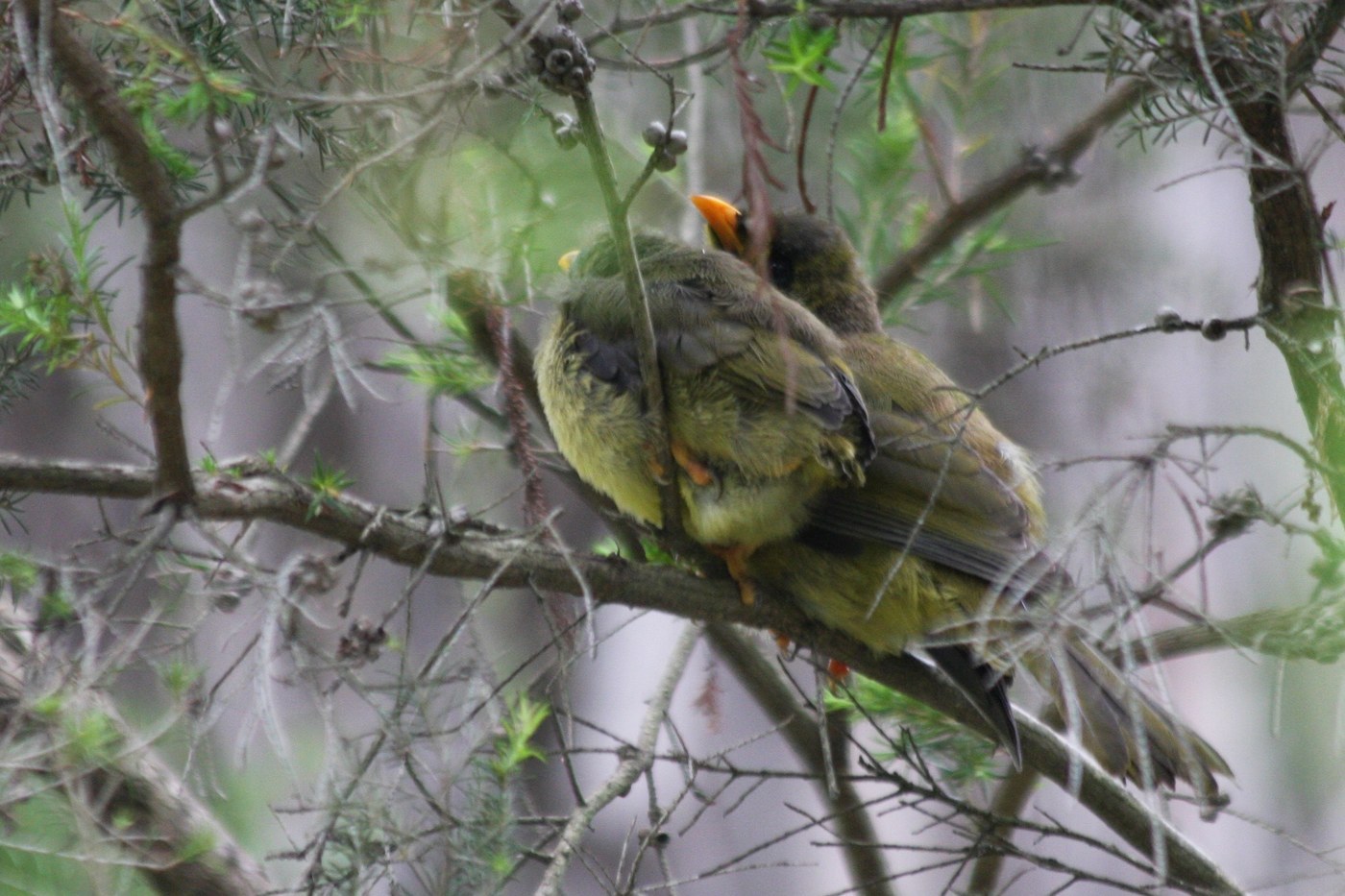
Bell Miner
Manorina melanophrys
The Bell Miner is a small, olive-green Australian honeyeater famous for the incessant, tinkling 'ping' calls of its dense colonies.
- Feather type
- Soft, dense contour feathers typical of a colonial honeyeater
- Colours
- Olive-green body with yellow-olive tones and an orange-yellow bill
- Bird size
- Small honeyeater, ~19 cm
Found a feather like this?
Identify any feather from a photo, free.
Overview
Overview
The Bell Miner is a colonial honeyeater endemic to southeastern Australia, named for its bell-like, single-note calls that ring out constantly from its colonies. Colonies can number from a handful to hundreds of birds and are strongly territorial, aggressively excluding most other small birds from their patch of forest.
- Family: Meliphagidae (honeyeaters)
- Distribution: coastal and near-coastal forests of eastern Australia
- Social structure: cooperative, colonial, with helpers at the nest
Identifying the Feather
Feather Identification
Bell Miner feathers are small, soft, and olive-green overall, with a yellowish wash strongest on the face, throat, and underparts. Flight feathers are dusky olive with narrow yellow-green edging, giving a subtly two-toned look when the wing is spread. Tail feathers are short and squared, olive above with faint pale edges.
- Overall tone: uniform olive-green, lacking bold contrast
- Bill and legs: bright orange-yellow, a useful colour cue on the whole bird
- Compare with: New Holland Honeyeater (bolder black-white-yellow streaking) and Little Wattlebird (larger, grey-brown, rufous wing patch)
Plumage & Molt
Plumage
Sexes look alike, with dull olive-green plumage overall and a slightly brighter yellow tinge on the face and belly. Juveniles are similar to adults but a touch duller with a less vivid bill colour. There is no strongly differentiated seasonal plumage; feather wear through the year gives slight variation in brightness, refreshed by a post-breeding moult.
Habitat & Range
Habitat & Range
Bell Miners favour wet or moist eucalypt forest, especially where an understorey of lantana or similar dense shrubs persists, along the coast and ranges of eastern Australia from southeastern Queensland to Victoria. Colonies are sedentary, defending the same patch of forest for many years.
Behavior & Field Notes
Behavior & Field Notes
Bell Miners feed largely on lerp (the sugary coverings produced by sap-sucking psyllid insects) and honeydew, which they farm by suppressing insectivorous birds that would otherwise control the insects. Nests are small, cup-shaped structures built low in dense foliage, and several birds help feed the young. Their calls are a constant, high, bell-like 'tink' repeated from within the canopy, often the first clue to a colony's presence.
- Diet: lerp, honeydew, and some insects
- Voice: repetitive, metallic, bell-like single notes
- Field note: presence often correlates with dieback in eucalypt canopies due to their insect-farming habit
Frequently asked questions
Why is it called the Bell Miner?
Its call is a repeated, high, metallic 'ting' or 'ping' that sounds like a tiny bell, given almost continuously by colony members.
How can I tell a Bell Miner from a Noisy Miner?
Bell Miners are smaller and uniformly olive-green with an orange-yellow bill, while Noisy Miners are grey with a black mask and yellow bill patch.
Do Bell Miners migrate?
No, colonies are highly sedentary and typically remain in the same forest patch year-round.
What kind of feathers would I find from a Bell Miner?
Small, soft, olive-green contour feathers with a yellowish wash, and short olive tail feathers with faint pale edging.
Bell Miner guides
In-depth guides for identifying and understanding Bell Miner.
Other feathers you may enjoy

Yellow-breasted Bunting
Contour and flight feathers, chestnut-and-yellow breeding pattern

Sedge Wren
Tiny streaked crown and back feathers

Yellow-winged Cacique
Glossy black body feathers, yellow wing patch, shaggy crest

Yellow Warbler
Small contour and flight feathers

Yellow-throated Warbler
Small contour and flight feathers

Yellow-throated Vireo
Bright yellow throat and spectacle feathers; olive-green back feathers; two white wing-bar feathers

Yellow-rumped Warbler
Small contour and flight feathers

Yellow-hooded Blackbird
Contrasting hood and body feathers

Yellow-headed Blackbird
Glossy black body plumage with a bright yellow head and breast

Yellow-eyed Junco
Contour and flight feathers

Yellow-fronted Canary
Small, smooth body plumage

Yellow-breasted Greenfinch
Compact, smooth body plumage