
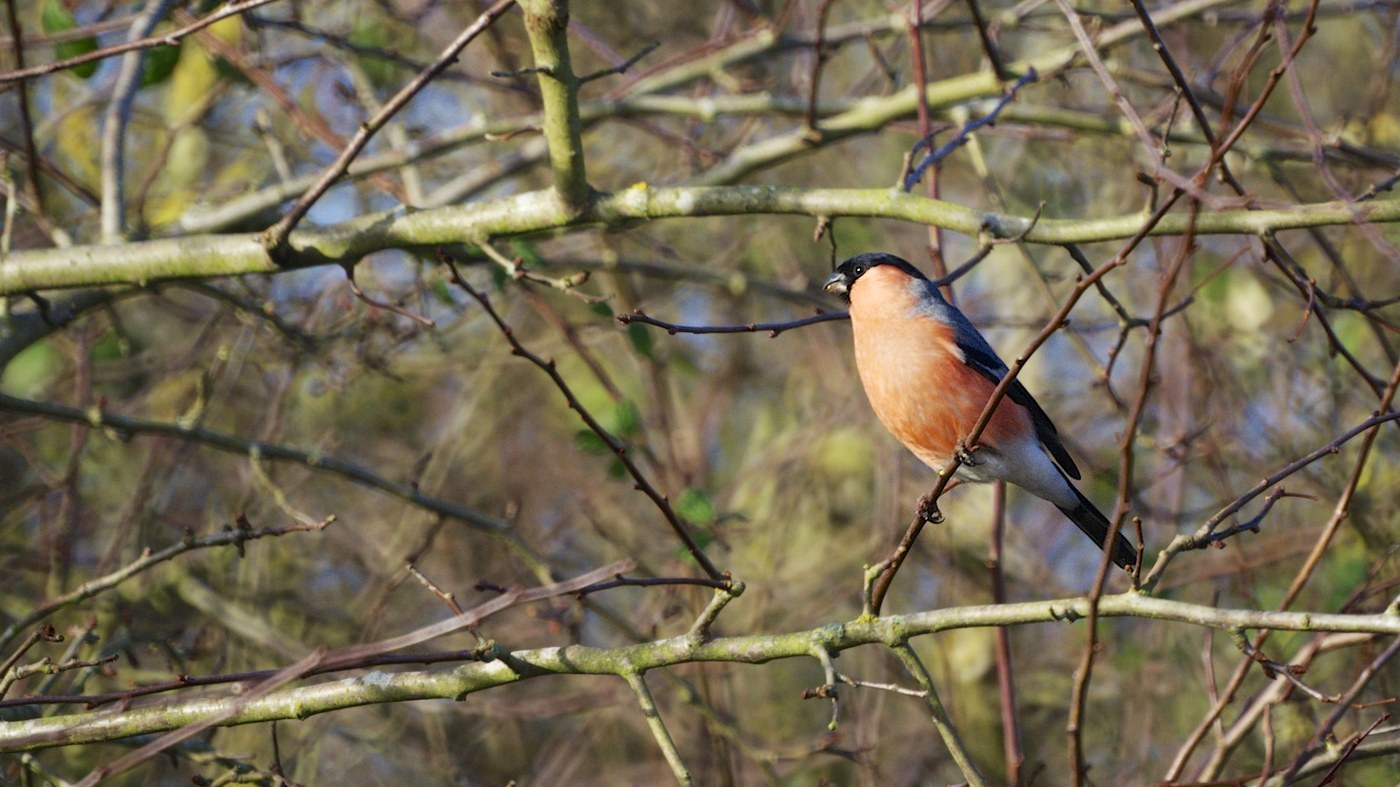
Common Bullfinch
Pyrrhula pyrrhula
A stocky, shy woodland finch with males showing rosy-pink underparts against a blue-grey back and black cap, and both sexes sharing a bold white rump patch that flashes distinctively in flight.
- Feather type
- Sturdy, soft finch contour feathers; flight feathers with a white wing bar and bold white rump
- Colours
- Male: rosy-pink underparts, blue-grey back, black cap and face; female: duller buff-grey below
- Bird size
- Small-medium, ~14.5-16.5 cm
Found a feather like this?
Identify any feather from a photo, free.
Overview
The Common Bullfinch is a stocky, somewhat retiring finch of woodland edge, hedgerows, and orchards, with males displaying a striking rosy-pink breast against blue-grey upperparts and a glossy black cap, while females show a more subdued buff-grey below. Both sexes share a bold white rump patch, one of the most useful features for identifying this species in flight.
It tends to stay within dense cover, often detected first by its soft, mournful piping call before it is seen, and its feathers may be found in dense hedgerows and woodland edge habitat.
The bold white rump patch combined with a black cap and stout, rounded bill shape are useful identification clues even from an isolated feather.
Identifying the Feather
Identifying Common Bullfinch feathers
- Male underpart feathers: Rich rosy-pink, unmarked, contrasting strongly with the blue-grey back.
- Female underpart feathers: Duller buff-grey to pinkish-buff, more subdued than the male's vivid pink.
- Head feathers: Glossy black cap and face in both sexes, contrasting with the grey or pink body.
- Rump feathers: Bold, bright white, one of the most striking features of this species, clearly visible as a flash in flight.
- Wing feathers: Black with a single white wingbar.
- Compared to similar species: The combination of a black cap, bold white rump, and rosy-pink (male) or buff-grey (female) underparts is not closely matched by any other common European finch, making Bullfinch feathers relatively easy to confirm.
Plumage & Molt
Plumage overview
Adult males show a glossy black cap and face, blue-grey back, rosy-pink underparts, a bold white rump, and black wings with a white bar. Females share the same head and rump pattern but have duller buff-grey to pinkish-buff underparts and a browner-grey back rather than blue-grey.
Juveniles lack the black cap entirely, appearing plain brownish overall, and acquire the black cap and adult-type body color through their first molt in late summer to early autumn.
Habitat & Range
Habitat and range
Common Bullfinches are found across much of Europe and temperate Asia, inhabiting woodland edge, hedgerows, orchards, and dense scrub, generally favoring areas with thick cover. Most populations are resident, though northern populations may show some local movement in harsh winters.
It tends to occur at lower densities than many other common finches, reflecting its more secretive, cover-dependent habits.
Behavior & Field Notes
Behavior and field notes
Common Bullfinches forage on buds, seeds, and berries, and are notable for their fondness for fruit tree buds in spring, which has historically brought them into conflict with orchard growers. They are typically found in pairs or small family groups rather than large flocks.
Its call is a soft, low, mournful piping whistle, often the first indication of its presence given how easily it stays hidden in dense cover. Nests are flimsy platforms of twigs built in dense shrubs or hedges. A useful field note: a black-capped feather with rosy-pink underparts and a bold white rump found in hedgerow or woodland edge habitat is a strong indicator of a male Common Bullfinch.
Frequently asked questions
What is the most distinctive Bullfinch feather feature?
The bold white rump patch combined with a glossy black cap, both present in males and females alike.
How do male and female Common Bullfinch feathers differ?
Males show vivid rosy-pink underparts and a blue-grey back, while females show duller buff-grey underparts and a browner-grey back, though both share the black cap and white rump.
Do juvenile Bullfinches have a black cap?
No, juveniles lack the black cap entirely, appearing plain brown until their first molt produces the adult head pattern.
Where are Common Bullfinch feathers commonly found?
In dense hedgerows, woodland edge, and orchards across Europe, reflecting this species' preference for thick cover.
Common Bullfinch guides
In-depth guides for identifying and understanding Common Bullfinch.
Other feathers you may enjoy

Yellow-breasted Bunting
Contour and flight feathers, chestnut-and-yellow breeding pattern

Sedge Wren
Tiny streaked crown and back feathers

Yellow-winged Cacique
Glossy black body feathers, yellow wing patch, shaggy crest

Yellow Warbler
Small contour and flight feathers

Yellow-throated Warbler
Small contour and flight feathers

Yellow-throated Vireo
Bright yellow throat and spectacle feathers; olive-green back feathers; two white wing-bar feathers

Yellow-rumped Warbler
Small contour and flight feathers

Yellow-hooded Blackbird
Contrasting hood and body feathers

Yellow-headed Blackbird
Glossy black body plumage with a bright yellow head and breast

Yellow-eyed Junco
Contour and flight feathers

Yellow-fronted Canary
Small, smooth body plumage

Yellow-breasted Greenfinch
Compact, smooth body plumage