
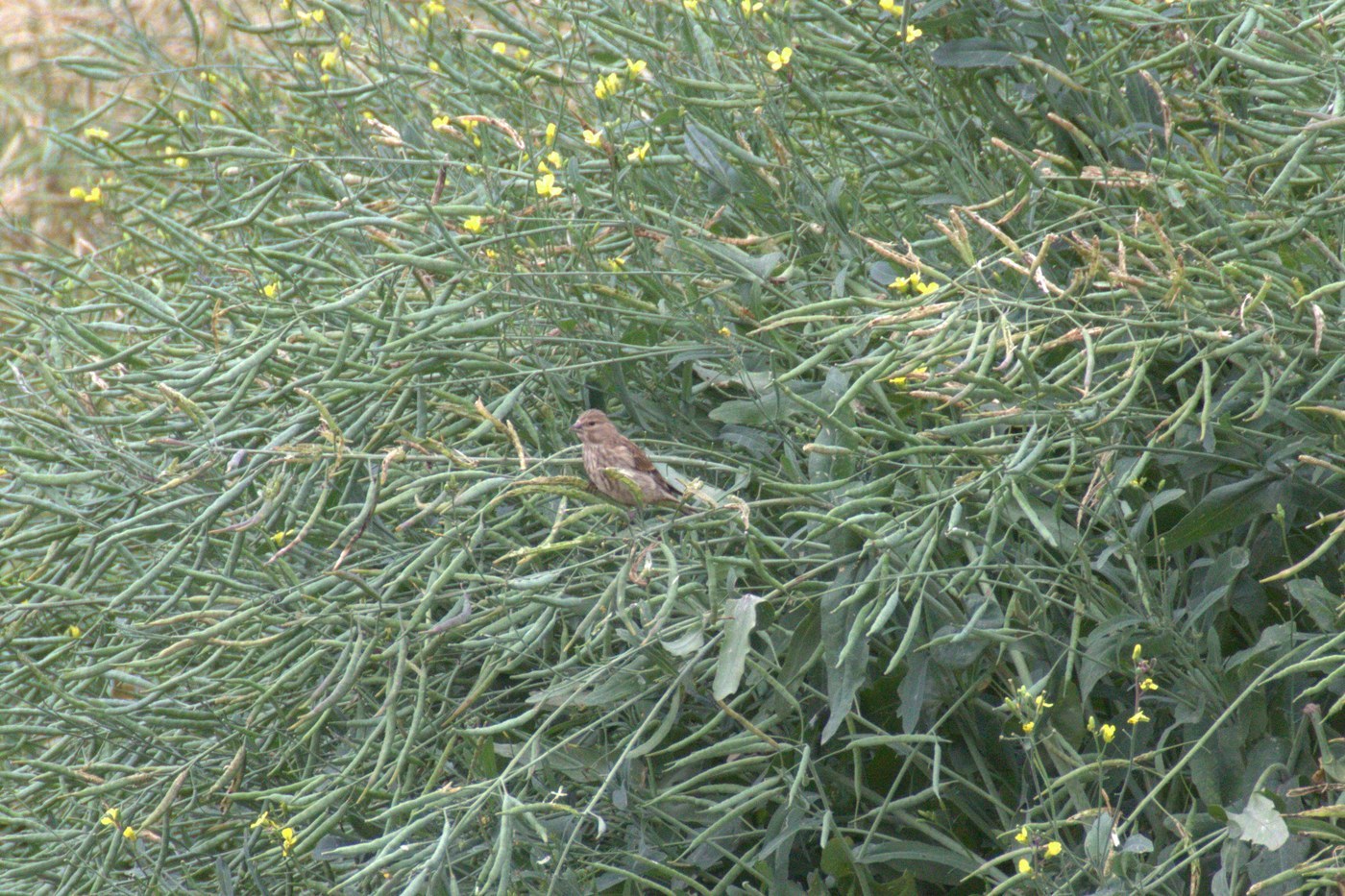
Common Linnet
Linaria cannabina
An open-country finch with a warm brown body overall, breeding males adding a crimson forehead and breast patch atop a grey head and chestnut back, with pale wing and tail panels visible in flight.
- Feather type
- Sturdy finch contour feathers; flight and tail feathers with pale panels
- Colours
- Brown overall; breeding male with a crimson forehead and breast patch, grey head, chestnut back
- Bird size
- Small, ~13-14 cm
Found a feather like this?
Identify any feather from a photo, free.
Overview
The Common Linnet is a finch of open scrubby country, farmland hedgerows, and heathland, historically valued in Europe for its melodious song. Breeding males develop a striking crimson forehead and breast patch that fades outside the breeding season, making seasonal timing important for feather identification.
It forms flocks outside the breeding season, foraging on the ground for seeds in open habitat, and its feathers may be found in these settings, particularly near gorse and scrub.
The combination of chestnut back, grey head, and pale wing panels is present year-round, while the crimson patches are a breeding-season feature primarily seen in males.
Identifying the Feather
Identifying Common Linnet feathers
- Breeding male head/breast feathers: Crimson-red forehead and breast patch, present only in breeding condition and absent in non-breeding males, females, and juveniles.
- Back feathers: Warm chestnut-brown, contrasting with a grey head in breeding males (head is more uniformly brown in females and non-breeding males).
- Wing feathers: Dark with pale whitish panels formed by pale feather edges, visible as a pale flash on the closed wing.
- Tail feathers: Dark with white edging along the outer feathers, visible in flight.
- Compared to similar species: The pale wing panel combined with chestnut back separates Linnet from Redpoll, which shows more streaking and a red forehead patch rather than a red breast patch as in male Linnet.
Plumage & Molt
Plumage overview
Breeding males show a grey head, chestnut-brown back, crimson forehead and breast patch, and whitish underparts, with pale wing and tail panels. Females and non-breeding males lack the crimson patches, appearing streaked brown overall with the same chestnut back tone and pale wing panels.
Juveniles are more heavily streaked below than adults. The crimson breeding patches in males are acquired through feather wear over winter and spring (pale feather tips abrading away), similar to the mechanism seen in Brambling, rather than through an additional molt.
Habitat & Range
Habitat and range
Common Linnets are widespread across Europe, North Africa, and parts of western Asia, favoring open scrubland, heathland with gorse, farmland hedgerows, and coastal scrub. Northern and eastern populations are migratory, moving south and west in winter, while southern populations tend to be more resident.
Its historical popularity as a cage bird for its song led to significant population pressure in past centuries, though wild populations remain widespread today.
Behavior & Field Notes
Behavior and field notes
Common Linnets forage on the ground and in low vegetation for small seeds, particularly from weeds and arable plants, and form flocks outside the breeding season that forage together in open fields and scrub.
Its song is a pleasant, varied twittering mix of musical and buzzy notes, historically prized in aviculture. Nests are built low in dense gorse, hawthorn, or other thorny scrub. A useful field note: a chestnut-backed, pale-wing-panel feather found near gorse or scrubland, especially with a crimson patch, is a strong indicator of a breeding male Common Linnet.
Frequently asked questions
Do all Common Linnets have red feathers?
No, only breeding males show the crimson forehead and breast patch; females and non-breeding males lack this red coloring.
How does a breeding male Linnet acquire its red patches?
Through feather wear over winter and spring, as pale feather tips abrade away to reveal the crimson color beneath, rather than through an additional molt.
How is a Linnet feather different from a redpoll feather?
Linnet shows a chestnut back and pale wing panels with a red breast patch in males, while redpoll is streakier overall with a red forehead patch rather than breast patch.
Where are Common Linnet feathers commonly found?
Near gorse, heathland, farmland hedgerows, and open scrubland across Europe, where this species forages and nests.
Common Linnet guides
In-depth guides for identifying and understanding Common Linnet.
Other feathers you may enjoy

Yellow-breasted Bunting
Contour and flight feathers, chestnut-and-yellow breeding pattern

Sedge Wren
Tiny streaked crown and back feathers

Yellow-winged Cacique
Glossy black body feathers, yellow wing patch, shaggy crest

Yellow Warbler
Small contour and flight feathers

Yellow-throated Warbler
Small contour and flight feathers

Yellow-throated Vireo
Bright yellow throat and spectacle feathers; olive-green back feathers; two white wing-bar feathers

Yellow-rumped Warbler
Small contour and flight feathers

Yellow-hooded Blackbird
Contrasting hood and body feathers

Yellow-headed Blackbird
Glossy black body plumage with a bright yellow head and breast

Yellow-eyed Junco
Contour and flight feathers

Yellow-fronted Canary
Small, smooth body plumage

Yellow-breasted Greenfinch
Compact, smooth body plumage