
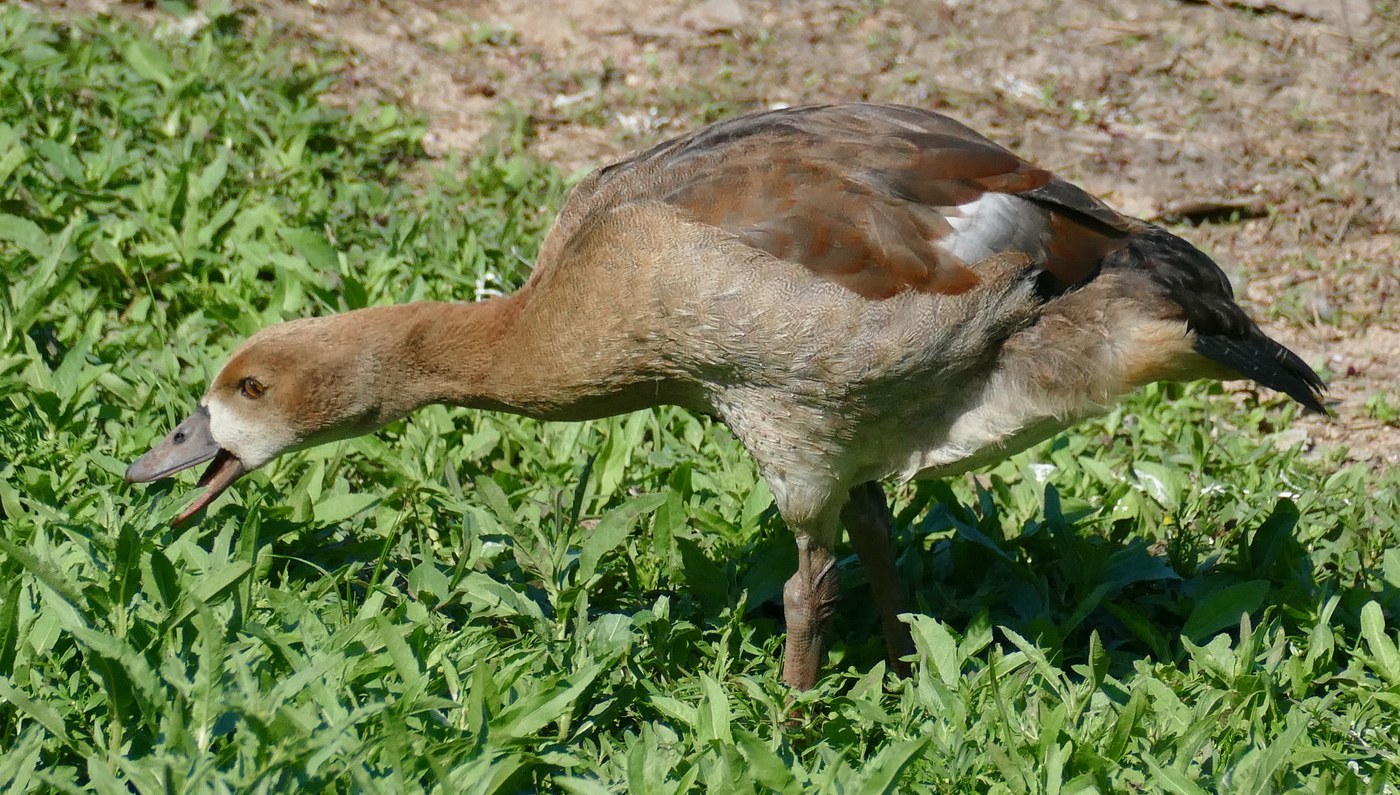
Egyptian Goose
Alopochen aegyptiaca
A pale buff-brown African waterfowl, more closely related to shelducks than true geese, marked by a dark chestnut eye patch, a chestnut breast smudge, and a bold white wing patch bordered in iridescent green.
- Feather type
- Contour and flight feathers
- Colours
- Buff-brown with chestnut eye and breast patches, white wing patch, green speculum
- Bird size
- Medium goose, ~68 cm
Found a feather like this?
Identify any feather from a photo, free.
Overview
The Egyptian Goose is native to the Nile Valley and sub-Saharan Africa but has become well established as a naturalized breeder in parts of Europe and the southeastern United States, particularly around parks, golf courses, and ornamental ponds. Despite its common name, it is more closely allied to shelducks than to true geese.
Identifying the Feather
Body feathers are pale buff-gray to brown overall. A distinctive dark brown patch of feathers surrounds the eye, and a chestnut smudge marks the center of the breast. In flight, and on isolated feathers, a large white patch across the upperwing coverts is bordered by a narrow black band and an iridescent green speculum—this white-and-green wing patch is one of the most reliable identification features even from a single feather. Legs are pink.
Plumage & Molt
Sexes look alike, though males average slightly larger. Juveniles are duller and lack the well-defined dark eye patch and chestnut breast spot, acquiring full adult pattern within their first year.
Habitat & Range
Native to the Nile Valley and much of sub-Saharan Africa, favoring wetlands, rivers, and lakes, often well away from dense cover. Naturalized populations breed in the Netherlands, Britain, and other parts of Europe, as well as Florida, typically around ponds, parks, and other urban or suburban water features.
Behavior & Field Notes
Forages on grasses, seeds, and aquatic vegetation, often grazing on lawns and open ground near water. Notably aggressive and territorial, especially during breeding season, frequently chasing off other waterfowl. Nests in tree cavities, on ledges, or on the ground, and is vocal with loud hissing and harsh honking calls.
Frequently asked questions
Is the Egyptian Goose a true goose?
No, despite its name it is more closely related to shelducks than to the true geese in the genus Anser or Branta.
What is the best feather clue for Egyptian Goose?
A large white patch on the upperwing coverts bordered by an iridescent green speculum, visible on individual wing feathers.
Where did Egyptian Geese originate?
They are native to the Nile Valley and sub-Saharan Africa, but naturalized populations now breed in parts of Europe and Florida.
Are Egyptian Geese aggressive?
Yes, they are known for defending territories vigorously, often displacing other waterfowl from shared ponds during the breeding season.
Egyptian Goose guides
In-depth guides for identifying and understanding Egyptian Goose.

Other feathers you may enjoy

Mallard
Wing (speculum), body, and tail feathers

Spectacled Eider
Large sea-duck body feathers with distinctive eye-ring patches

Canada Goose
Body and flight feathers
Mute Swan
Body (contour) and flight feathers

Wood Duck
Iridescent crest feathers; ornate scapular and flank feathers; white teardrop facial feathers (female)
Whooper Swan
Contour and flight feathers

White-winged Scoter
Large sea-duck body feathers with a white wing patch

Ruddy Duck
Stiff tail feathers and compact body plumage

Ross's Goose
Contour and flight feathers

White-cheeked Pintail
Contour and elongated tail feathers

Torrent Duck
Dense, sleek contour feathers; stiff, pointed tail feathers used for bracing against rocks

Tundra Swan
Contour and flight feathers