
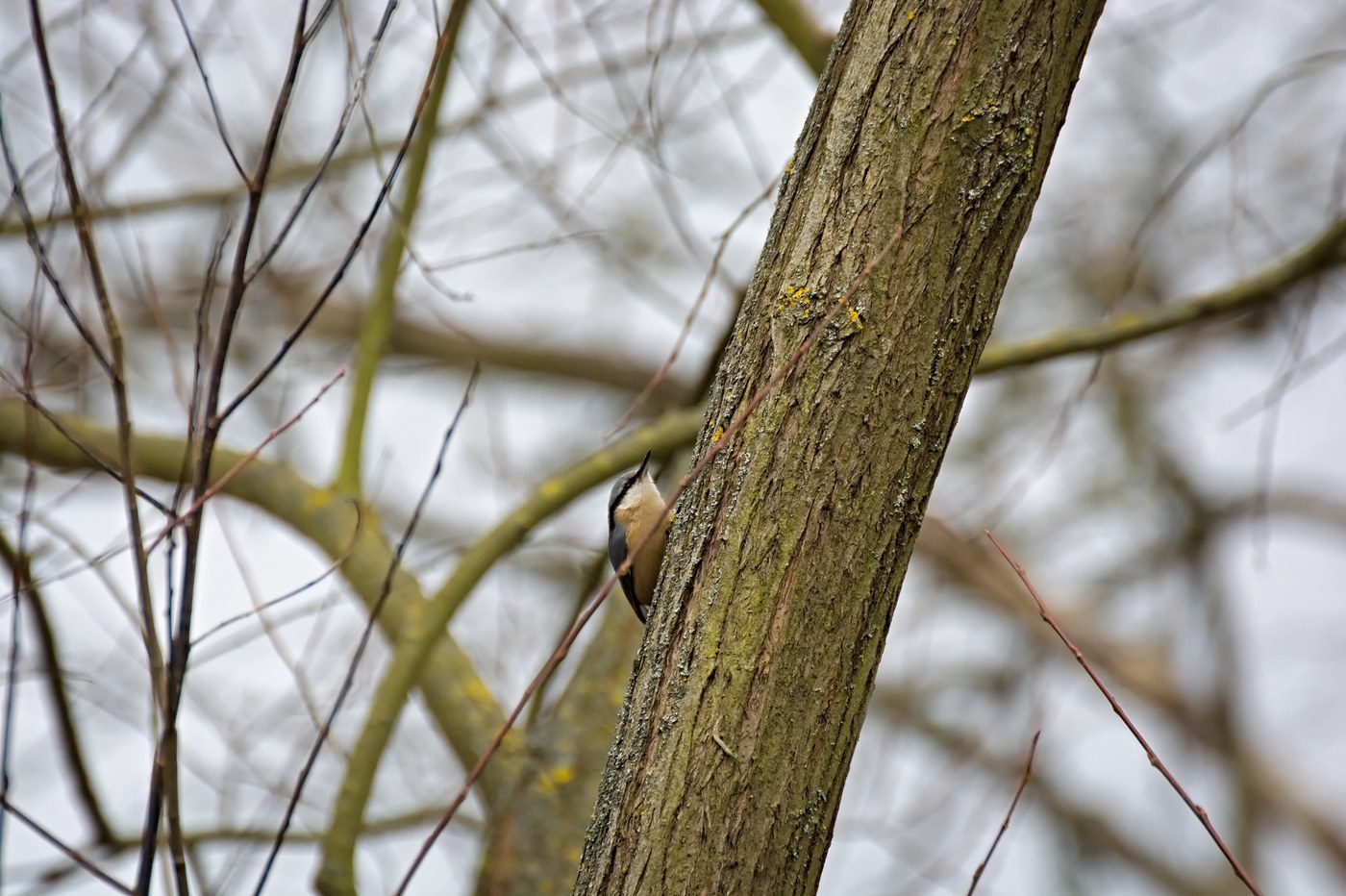
Eurasian Nuthatch
Sitta europaea
The Eurasian Nuthatch is a stocky, tree-climbing songbird with slate-blue upperpart feathers and warm buff-orange underparts, plus short, stiff tail feathers adapted for headfirst descents down tree trunks.
- Feather type
- Short, squared tail feathers used for climbing support; compact rounded wings; dense contour feathers
- Colours
- Blue-grey upperparts, warm buff-orange underparts (deeper chestnut on flanks), black eye-stripe
- Bird size
- Sparrow-sized, ~14 cm
Found a feather like this?
Identify any feather from a photo, free.
Overview
The Eurasian Nuthatch is a compact, large-headed woodland bird recognized by its blue-grey back and black eye-stripe. Unlike woodpeckers, it can climb down tree trunks headfirst, using strong feet rather than tail support.
It is widespread across European and Asian woodlands, favoring mature trees with loose bark and cavities for nesting.
Its feathers combine a smooth slate-blue back with a warm rusty-buff breast, a color combination distinctive among woodland songbirds found beneath trees.
Identifying the Feather
Size & Shape
- Body feathers are dense and smooth; tail feathers are notably short and squared-off compared to most songbirds, since the tail is not used as a climbing prop.
- Wing feathers are rounded, built for short, direct flights between trees.
Color & Pattern
- Upperpart feathers: uniform blue-grey, unmarked.
- Underpart feathers: warm buff-orange, deepening to chestnut on the flanks and undertail in adults (especially males).
- A bold black eye-stripe runs from the bill through the eye to the nape.
- Throat feathers are whitish, contrasting with the buff breast.
Similar Species
- No common European woodland songbird combines slate-grey upperparts with orange-buff underparts and a black eye mask in this way, making Nuthatch feathers fairly distinctive once color is visible.
Plumage & Molt
Overall Plumage
Blue-grey above, buff-orange to chestnut below, white throat, and a black eye-stripe extending onto the ear coverts.
Sex & Age Differences
Males typically show deeper chestnut flank and undertail feathers than females, which are paler buff overall. Juveniles resemble adults but are duller and less richly colored until their first molt.
Molt
Adults have a single complete molt in late summer after breeding; juveniles undergo a partial post-juvenile molt of body feathers, retaining juvenile flight feathers into their first winter.
Habitat & Range
Habitat
Mature broadleaf and mixed woodland with old trees offering bark crevices and holes; also parks and large gardens with established trees.
Range
Widespread across Europe (absent from Ireland and northern Scotland) through temperate Asia to Japan.
Movements
Largely resident and sedentary, defending a year-round territory around a nest hole.
Behavior & Field Notes
Behavior
Forages by climbing tree trunks and branches in any direction, including headfirst downward, probing bark for food.
Diet
Takes insects and other invertebrates from bark crevices, along with seeds and nuts which it wedges into bark to hammer open.
Nesting
Uses a natural tree cavity or old woodpecker hole, plastering the entrance with mud to reduce the opening to its own size.
Voice
Loud, ringing calls and a repeated 'pew-pew-pew' or trilling whistle carrying through woodland.
Field Notes
Feathers are often found at the base of mature trees; the blue-grey and orange-buff combination with a black eye-stripe reliably identifies this species.
Frequently asked questions
What color are Nuthatch back feathers?
A uniform slate blue-grey, unmarked and smooth.
Why are Nuthatch tail feathers short?
Because the species climbs down trunks headfirst using its feet, not its tail, for support, unlike woodpeckers.
How do I tell male from female Nuthatch feathers?
Males usually show deeper chestnut flank/undertail feathers; females are paler buff in the same areas.
What habitat feathers come from this bird?
Mature deciduous or mixed woodland with old, cavity-bearing trees.
Eurasian Nuthatch guides
In-depth guides for identifying and understanding Eurasian Nuthatch.
Other feathers you may enjoy

Yellow-breasted Bunting
Contour and flight feathers, chestnut-and-yellow breeding pattern

Sedge Wren
Tiny streaked crown and back feathers

Yellow-winged Cacique
Glossy black body feathers, yellow wing patch, shaggy crest

Yellow Warbler
Small contour and flight feathers

Yellow-throated Warbler
Small contour and flight feathers

Yellow-throated Vireo
Bright yellow throat and spectacle feathers; olive-green back feathers; two white wing-bar feathers

Yellow-rumped Warbler
Small contour and flight feathers

Yellow-hooded Blackbird
Contrasting hood and body feathers

Yellow-headed Blackbird
Glossy black body plumage with a bright yellow head and breast

Yellow-eyed Junco
Contour and flight feathers

Yellow-fronted Canary
Small, smooth body plumage

Yellow-breasted Greenfinch
Compact, smooth body plumage