
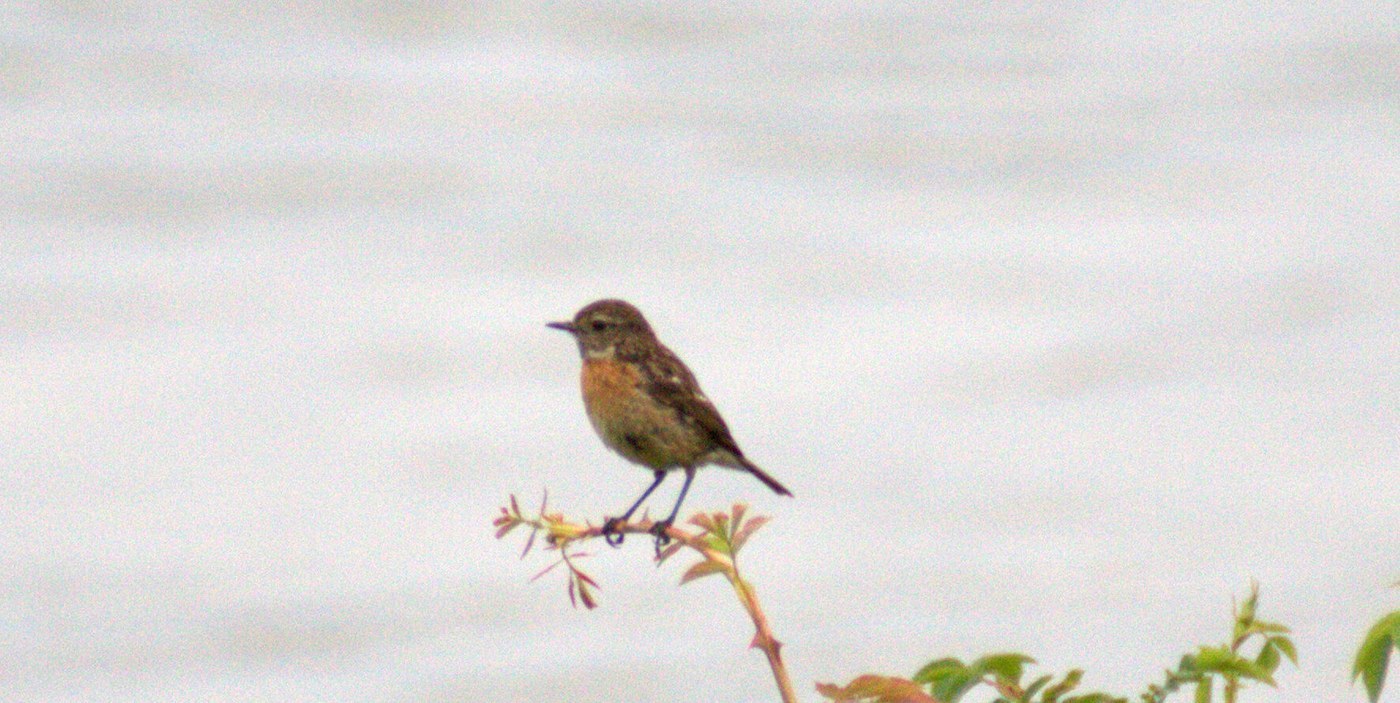
European Stonechat
Saxicola rubicola
The European Stonechat is a small, compact songbird whose breeding males show a jet-black head and orange-chestnut breast set off by white neck patches, against a mottled brown back.
- Feather type
- Compact contour feathers; short rounded wings; dark tail feathers
- Colours
- Black head (male), orange-chestnut breast, white neck patches, mottled brown back
- Bird size
- Small, ~12.5 cm
Found a feather like this?
Identify any feather from a photo, free.
Overview
The European Stonechat is a small, plump songbird of heathland and gorse scrub, often seen perched prominently on top of a bush.
Breeding males are boldly patterned with a black head, white half-collar, and orange breast, while females and juveniles show a much softer brown-streaked plumage.
It is largely resident in milder parts of its range, so its feathers can be found in heathland habitats throughout much of the year.
Identifying the Feather
Size & Shape
- Feathers are compact and rounded, matching the bird's plump, short-tailed build.
- Wing feathers are short and rounded, suited to low, fluttering flights between perches.
Color & Pattern
- Male head feathers: solid black, with white patches on the sides of the neck and a variable white wing patch.
- Male underparts: orange-chestnut breast fading to paler belly.
- Back feathers: streaked dark brown and buff in both sexes.
- Female/juvenile feathers: streaked brown overall, lacking the black head, with a paler orange-buff breast wash.
Similar Species
- Male's black head and white neck patches separate it from Whinchat, which shows a strong pale eyebrow instead of a black head; females of the two species are more similar and best told by structure and habitat.
Plumage & Molt
Overall Plumage
Males: black head, white neck patches, orange-chestnut breast, streaked brown back. Females/juveniles: streaked brown overall with a paler orange-buff breast.
Sex & Age Differences
Males are much more boldly patterned; females and juveniles are cryptically streaked brown. Juveniles are similar to females but spottier before their first molt.
Molt
One complete molt after breeding in late summer.
Habitat & Range
Habitat
Heathland, gorse and bramble scrub, coastal grassland, and rough open ground with scattered bushes.
Range
Widespread across western and southern Europe, North Africa, and parts of Asia.
Movements
Mostly resident in milder areas; northern and upland populations may move short distances or to coasts in winter.
Behavior & Field Notes
Behavior
Perches conspicuously on top of gorse or low bushes, flicking its wings and tail, and dropping to the ground to catch prey.
Diet
Feeds on insects and other small invertebrates caught on or near the ground.
Nesting
Builds a well-hidden grass nest low in dense gorse or scrub.
Voice
A hard, scolding 'tsak-tsak' call likened to two stones being knocked together, giving the bird its name.
Field Notes
A black-headed feather with white neck patches and an orange breast, found in heathland or gorse scrub, indicates a male Stonechat; streakier brown feathers in the same habitat likely belong to a female.
Frequently asked questions
What gives the Stonechat its name?
Its hard, scolding call resembles two stones being knocked together.
How do I tell a male Stonechat feather from a female's?
Males show a solid black head with white neck patches and an orange breast; females are streaked brown throughout with a paler breast wash.
Where would I find a Stonechat feather?
In heathland, gorse scrub, or rough grassland with scattered low bushes.
Is the Stonechat migratory?
Mostly resident in milder regions, though some populations move short distances in winter.
European Stonechat guides
In-depth guides for identifying and understanding European Stonechat.
Other feathers you may enjoy

Yellow-breasted Bunting
Contour and flight feathers, chestnut-and-yellow breeding pattern

Sedge Wren
Tiny streaked crown and back feathers

Yellow-winged Cacique
Glossy black body feathers, yellow wing patch, shaggy crest

Yellow Warbler
Small contour and flight feathers

Yellow-throated Warbler
Small contour and flight feathers

Yellow-throated Vireo
Bright yellow throat and spectacle feathers; olive-green back feathers; two white wing-bar feathers

Yellow-rumped Warbler
Small contour and flight feathers

Yellow-hooded Blackbird
Contrasting hood and body feathers

Yellow-headed Blackbird
Glossy black body plumage with a bright yellow head and breast

Yellow-eyed Junco
Contour and flight feathers

Yellow-fronted Canary
Small, smooth body plumage

Yellow-breasted Greenfinch
Compact, smooth body plumage