
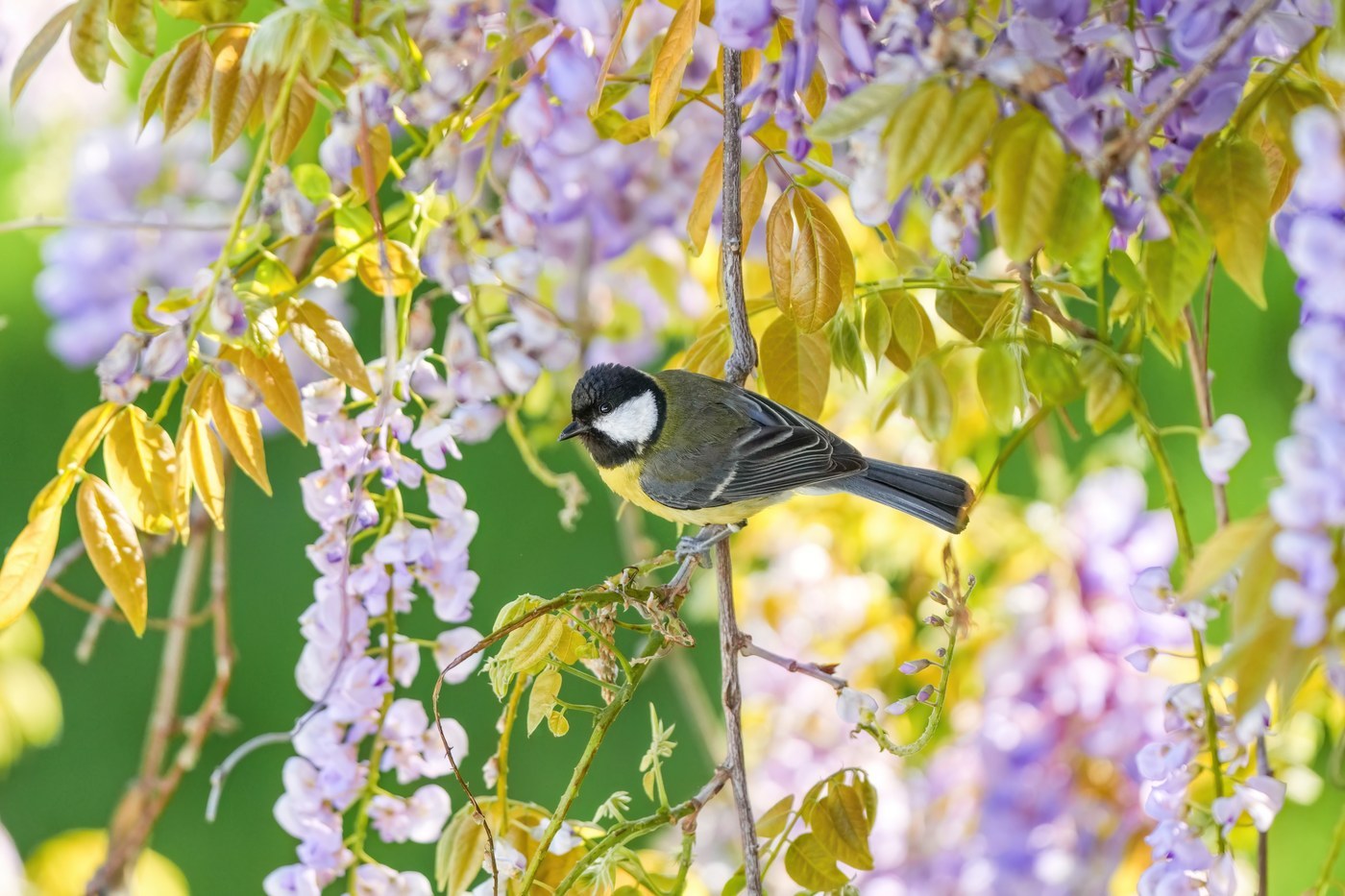
Great Tit
Parus major
A boldly patterned tit with a glossy black head and white cheeks, bright yellow underparts split by a black central stripe, and blue-grey wings with a white bar, among the most recognizable garden songbirds.
- Feather type
- Sturdy contour feathers with a bold belly stripe; short rounded flight feathers with a white wingbar
- Colours
- Black head with white cheeks, yellow underparts with a black central belly stripe, olive-green back, blue-grey wings
- Bird size
- Small, ~14 cm
Found a feather like this?
Identify any feather from a photo, free.
Overview
The Great Tit is the largest and one of the most widespread members of the tit family across Europe and Asia, instantly recognizable by its glossy black head, white cheek patches, and bold black stripe running down its yellow underparts. It is a common and confident visitor to gardens and feeders.
Its strong black-and-yellow contrast, combined with the diagnostic belly stripe, makes its feathers among the easier tit species to identify with confidence.
It is a cavity nester that readily uses nest boxes, so feathers are frequently found near nesting and feeding sites.
Identifying the Feather
Identifying Great Tit feathers
- Head feathers: Glossy black with bold white cheek patches, extending down the sides of the neck.
- Underpart feathers: Bright yellow, split by a broad black stripe running from the throat to the vent — wider in males than females, a useful sexing clue if the stripe is intact.
- Wing feathers: Blue-grey with a single bold white wingbar formed by white tips on the greater coverts.
- Back feathers: Olive-green, contrasting with the black head and blue-grey wings.
- Compared to similar species: The black central belly stripe is unique to Great Tit among common European tits — Blue Tit, Coal Tit, Marsh Tit, and Willow Tit all lack this feature entirely.
Plumage & Molt
Plumage overview
Adults show a glossy black head and throat, bold white cheeks, an olive-green back, blue-grey wings with a white wingbar, and yellow underparts divided by a black central stripe. Males typically show a broader, more continuous belly stripe than females, whose stripe is narrower and sometimes broken.
Juveniles are duller, with yellowish rather than white cheeks and a less defined belly stripe, molting into full adult plumage in their first autumn.
Habitat & Range
Habitat and range
Great Tits are widespread across Europe, much of temperate Asia, and parts of North Africa, occupying deciduous and mixed woodland, parks, hedgerows, and gardens. Most populations are resident year-round, though some northern and eastern populations show local seasonal movement in severe winters.
It is one of the most commonly observed and studied songbirds in Europe, frequently the subject of long-term behavioral research.
Behavior & Field Notes
Behavior and field notes
Great Tits forage in trees, shrubs, and on the ground for insects, seeds, and nuts, and are frequent, assertive visitors to bird feeders, sometimes dominating smaller tit species. They are cavity nesters, readily using nest boxes as well as natural tree holes.
Their song is a loud, distinctive "teacher-teacher-teacher" repeated call, one of the most recognizable songbird sounds in European gardens. A useful field note: a black-and-yellow feather with a visible dark central stripe strongly suggests Great Tit, since no other common tit shares this exact belly pattern.
Frequently asked questions
What is the key feature that separates Great Tit feathers from other tits?
The bold black stripe running down the center of the yellow underparts is unique to Great Tit among common European tit species.
Can I tell male and female Great Tits apart from their feathers?
Often yes — males tend to have a broader, more solid black belly stripe, while females show a narrower or sometimes broken stripe.
Do juvenile Great Tits have white cheeks like adults?
No, juveniles show yellowish cheeks rather than the crisp white of adults, along with a less defined belly stripe.
Where are Great Tit feathers commonly found?
Near nest boxes, garden feeders, and deciduous woodland, since this species readily uses both for nesting and foraging.
Great Tit guides
In-depth guides for identifying and understanding Great Tit.
Other feathers you may enjoy

Yellow-breasted Bunting
Contour and flight feathers, chestnut-and-yellow breeding pattern

Sedge Wren
Tiny streaked crown and back feathers

Yellow-winged Cacique
Glossy black body feathers, yellow wing patch, shaggy crest

Yellow Warbler
Small contour and flight feathers

Yellow-throated Warbler
Small contour and flight feathers

Yellow-throated Vireo
Bright yellow throat and spectacle feathers; olive-green back feathers; two white wing-bar feathers

Yellow-rumped Warbler
Small contour and flight feathers

Yellow-hooded Blackbird
Contrasting hood and body feathers

Yellow-headed Blackbird
Glossy black body plumage with a bright yellow head and breast

Yellow-eyed Junco
Contour and flight feathers

Yellow-fronted Canary
Small, smooth body plumage

Yellow-breasted Greenfinch
Compact, smooth body plumage