
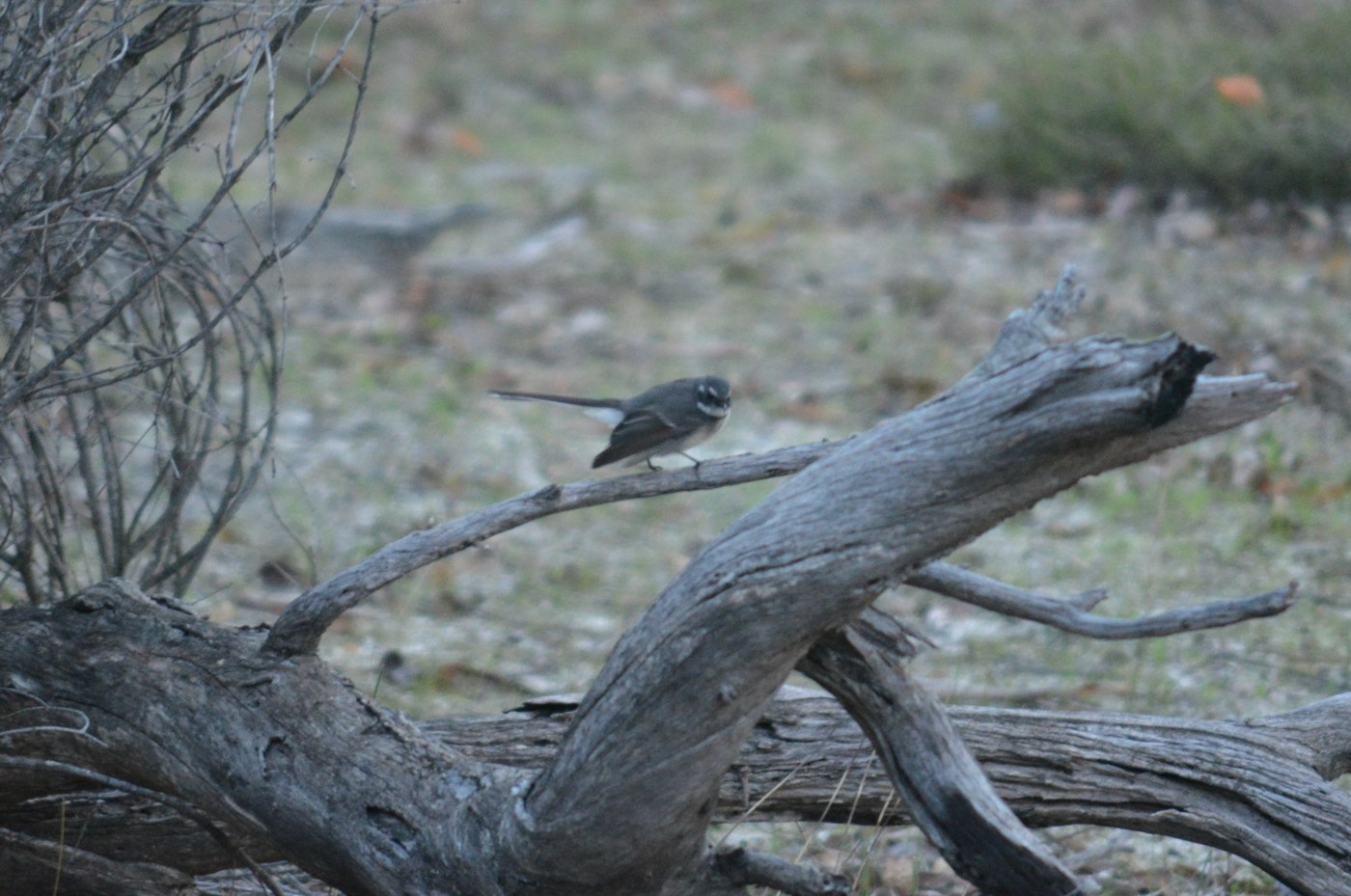
Grey Fantail
Rhipidura albiscapa
A small, restless Australian songbird, the Grey Fantail flits through woodland foliage with its broad tail fanned wide, showing gray upperparts and warm buff underparts.
- Feather type
- Small, soft contour feathers; broad, frequently fanned tail
- Colours
- Gray upperparts, buff-orange underparts, white-edged tail feathers
- Bird size
- Small songbird, ~15-16 cm including tail
Found a feather like this?
Identify any feather from a photo, free.
Overview
The Grey Fantail is a small, highly active songbird found across much of Australia in a wide range of wooded habitats. Like other fantails, it is instantly recognizable by its habit of fanning a broad tail while making quick, erratic flights after insects.
Identifying the Feather
The tail is broad and frequently spread into a fan, with white edging along the outer feathers that stands out against the darker central rectrices, a helpful feature on loose feathers. Upperparts are soft gray, while the underparts show a warm buff to orange wash, a combination that separates this species from the grayer-and-whiter New Zealand Fantail. A pale, thin eyebrow stripe and subtle facial markings are present but less bold than in some fantail relatives. Wings are short and rounded, built for agile, erratic flight rather than distance. The buff underpart tone combined with white outer tail edges is a useful combination for distinguishing this species from similar fantails.
Plumage & Molt
Sexes are similar in plumage. Juveniles are duller, with less defined buff tones and less crisp facial markings than adults. Molt is gradual and regular, maintaining the tail's fan shape and white edging throughout the year.
Habitat & Range
This species occupies a wide range of wooded habitats across Australia, including eucalypt forest, woodland, scrub, and vegetated gardens, generally avoiding only the most open treeless country. Southern populations may make seasonal movements to milder areas in winter, while other populations are largely sedentary.
Behavior & Field Notes
Grey Fantails feed on small flying insects caught in quick, erratic aerial sallies, often flitting close to observers who disturb insects while moving through vegetation. They build small, neat cup nests, sometimes with a hanging tail-like extension of material. Their call is a thin, high-pitched, cheerful series of notes, and their near-constant tail fanning and hopping motion make them conspicuous despite small size.
Frequently asked questions
How does the Grey Fantail differ from the New Zealand Fantail?
It shows warmer buff to orange underparts compared with the grayer-and-whiter tones of the New Zealand Fantail.
Does the Grey Fantail migrate?
Some southern populations move to milder areas in winter, while others remain largely resident year-round.
What is distinctive about its tail feathers?
The outer tail feathers are broad with white edging and are habitually fanned wide during foraging flights.
What does it eat?
Small flying insects, caught in quick, erratic aerial sallies.
Grey Fantail guides
In-depth guides for identifying and understanding Grey Fantail.
Other feathers you may enjoy

Yellow-breasted Bunting
Contour and flight feathers, chestnut-and-yellow breeding pattern

Sedge Wren
Tiny streaked crown and back feathers

Yellow-winged Cacique
Glossy black body feathers, yellow wing patch, shaggy crest

Yellow Warbler
Small contour and flight feathers

Yellow-throated Warbler
Small contour and flight feathers

Yellow-throated Vireo
Bright yellow throat and spectacle feathers; olive-green back feathers; two white wing-bar feathers

Yellow-rumped Warbler
Small contour and flight feathers

Yellow-hooded Blackbird
Contrasting hood and body feathers

Yellow-headed Blackbird
Glossy black body plumage with a bright yellow head and breast

Yellow-eyed Junco
Contour and flight feathers

Yellow-fronted Canary
Small, smooth body plumage

Yellow-breasted Greenfinch
Compact, smooth body plumage