
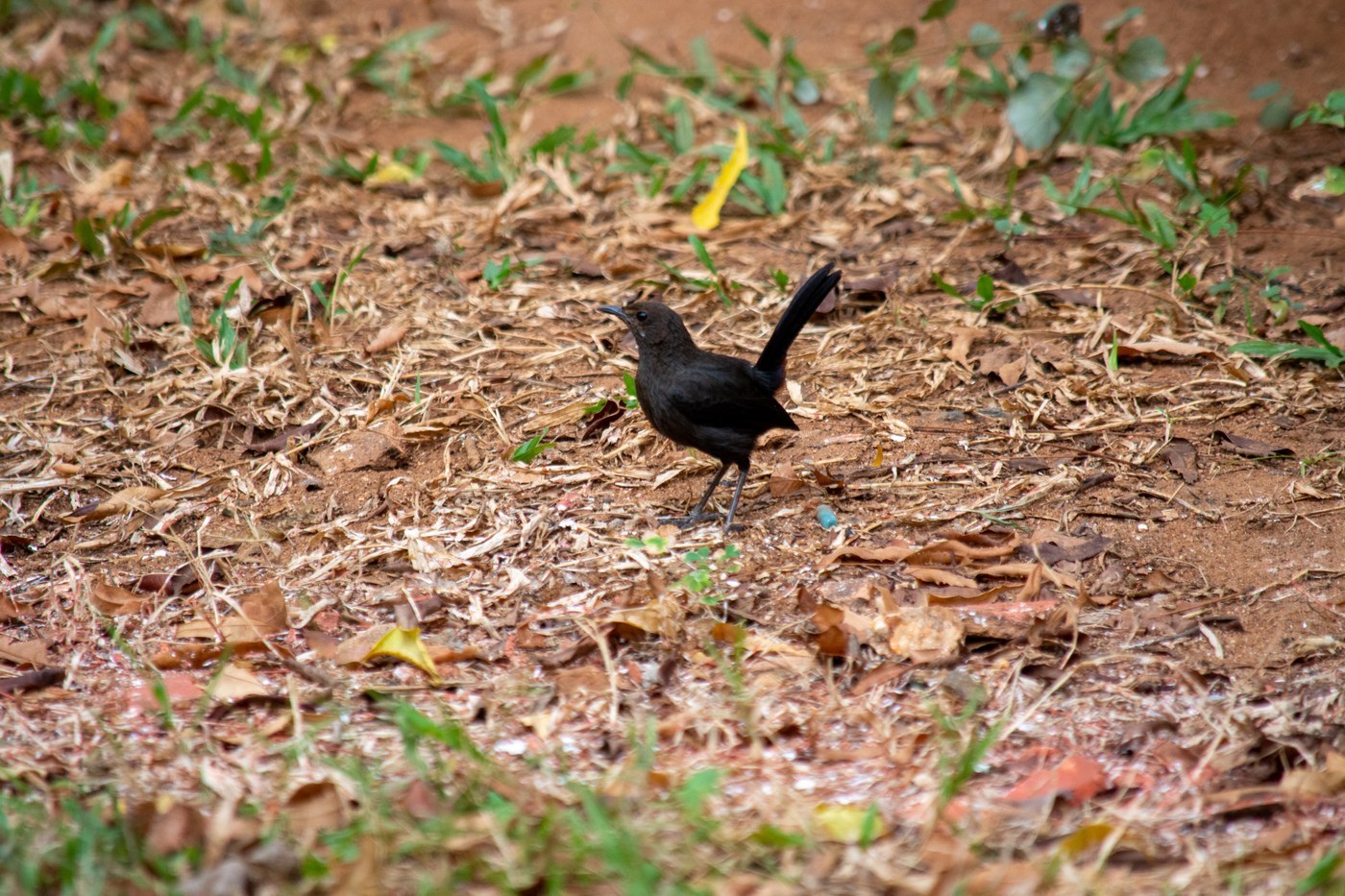
Indian Robin
Copsychus fulicatus
A small, confiding songbird of dry open country in South Asia, glossy black or brown with a chestnut patch under the tail that flashes as it forages on the ground.
- Feather type
- Small, sleek contour feathers; medium cocked tail
- Colours
- Glossy black or brown with rufous undertail coverts
- Bird size
- Sparrow-sized, ~19 cm
Found a feather like this?
Identify any feather from a photo, free.
Overview
The Indian Robin is a common and confiding small songbird of dry, open habitats across the Indian subcontinent, often seen running along bare ground, rocky outcrops, and roadside scrub. It is not closely related to the true robins of Europe or North America but shares a similarly bold, ground-foraging habit.
Two distinct plumage forms occur across its range: a glossy black-bodied form in southern India and Sri Lanka, and a brown-backed form in much of the rest of the subcontinent, both sharing the diagnostic rufous undertail patch.
Identifying the Feather
- Male (black form): Glossy black overall with a small white shoulder patch and rufous-chestnut undertail coverts
- Male (brown-backed form): Brown back and wings with a black face, throat, and underparts, plus the same rufous vent patch
- Tail is often held cocked or fanned, flashing the chestnut undertail coverts as a signal
- Female is duller grayish-brown throughout, retaining the rufous undertail patch but lacking the male's black or glossy tones
- Distinguished from similar chats by the combination of the cocked tail, rufous vent, and preference for open, dry ground
Plumage & Molt
Adult males show one of two regional plumage types, either glossy black or black-and-brown, both retaining a rufous-chestnut undertail patch visible when the tail is raised. Females are uniformly dull brownish-gray with a paler belly and the same chestnut vent patch, though less vivid than the male's. Juveniles resemble females but with subtle mottling on the breast before acquiring adult plumage.
Habitat & Range
The Indian Robin favors dry open country, scrubland, rocky hillsides, cultivated fields, and areas around human habitation across the Indian subcontinent and into parts of Iran and Sri Lanka. It is a resident species, generally not undertaking long migrations, though some local movement occurs with habitat change.
Behavior & Field Notes
This species forages mainly on the ground, running and hopping after insects and other small invertebrates, often flicking its tail up and down while foraging. Nests are built in cavities such as wall holes, rock crevices, or old tin cans and pipes near human structures, lined with grass and feathers. The song is a short, sweet warbling phrase, often delivered from a low perch or rock.
Frequently asked questions
What does an Indian Robin feather look like?
Male body feathers are glossy black or a mix of brown back with black underparts, always with rufous-chestnut feathers under the tail; females are duller brownish-gray with the same rufous vent patch.
How can I tell an Indian Robin from an Oriental Magpie-Robin?
The Indian Robin is smaller, lacks the white wing patch and white outer tail feathers of the magpie-robin, and shows a distinctive rufous-chestnut patch under the tail instead.
Why do Indian Robins have two different-looking plumages?
Populations vary geographically, with a glossy all-black form found in southern India and Sri Lanka and a brown-backed form found across much of the rest of the subcontinent.
Where do Indian Robins live?
They are found in dry open scrub, rocky ground, and cultivated land across the Indian subcontinent and neighboring regions.
Indian Robin guides
In-depth guides for identifying and understanding Indian Robin.
Other feathers you may enjoy

Yellow-breasted Bunting
Contour and flight feathers, chestnut-and-yellow breeding pattern

Sedge Wren
Tiny streaked crown and back feathers

Yellow-winged Cacique
Glossy black body feathers, yellow wing patch, shaggy crest

Yellow Warbler
Small contour and flight feathers

Yellow-throated Warbler
Small contour and flight feathers

Yellow-throated Vireo
Bright yellow throat and spectacle feathers; olive-green back feathers; two white wing-bar feathers

Yellow-rumped Warbler
Small contour and flight feathers

Yellow-hooded Blackbird
Contrasting hood and body feathers

Yellow-headed Blackbird
Glossy black body plumage with a bright yellow head and breast

Yellow-eyed Junco
Contour and flight feathers

Yellow-fronted Canary
Small, smooth body plumage

Yellow-breasted Greenfinch
Compact, smooth body plumage