
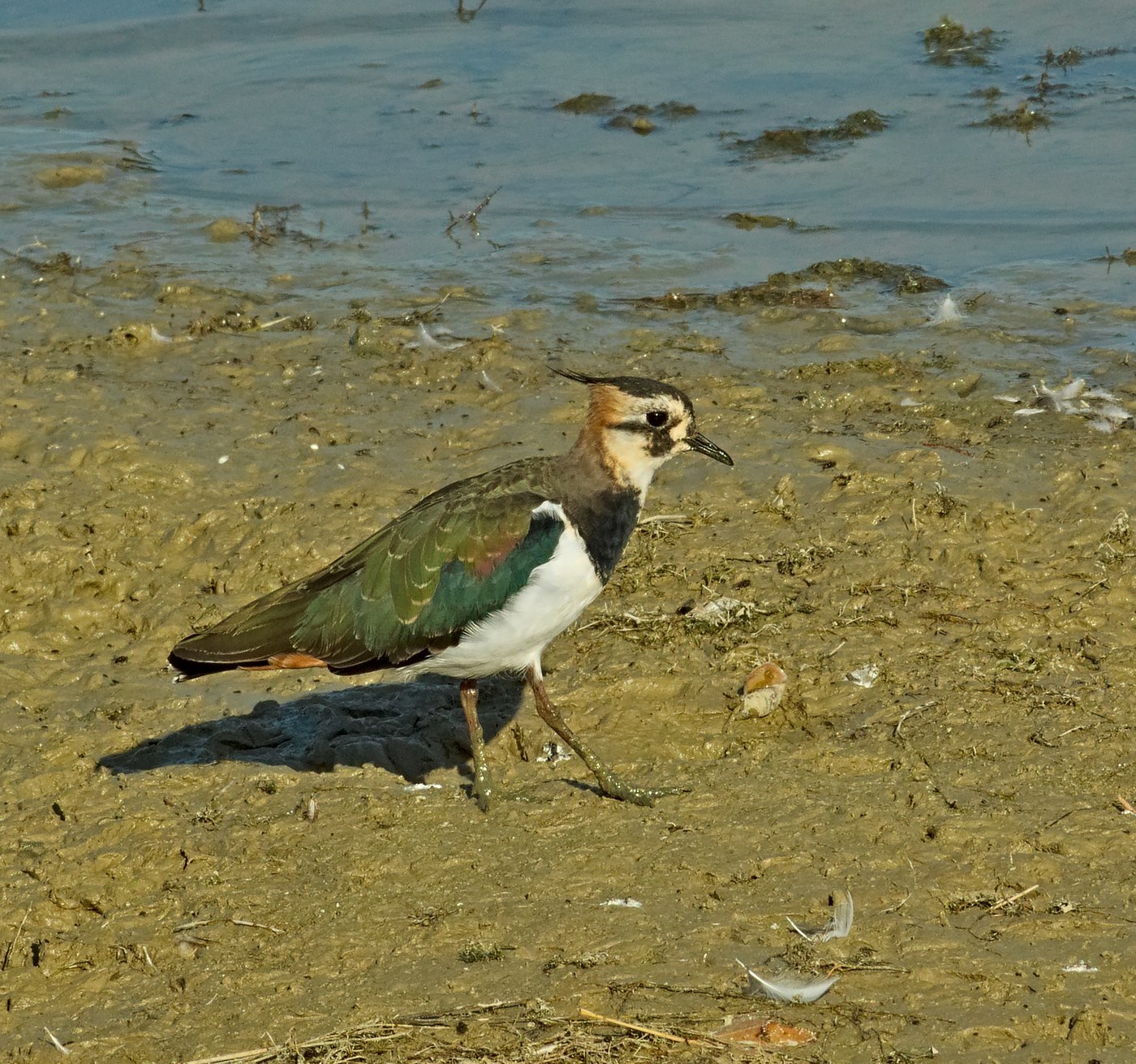
Northern Lapwing
Vanellus vanellus
A distinctive Eurasian plover with iridescent green-black upperparts, a long wispy black crest, and broad, rounded wings that give it a floppy, butterfly-like flight.
- Feather type
- Broad, rounded flight feathers; iridescent body feathers; long, wispy black crest plumes
- Colours
- Iridescent dark green-black upperparts glossed with purple and bronze, white underparts, and a long black crest
- Bird size
- Medium shorebird, ~28-31 cm
Found a feather like this?
Identify any feather from a photo, free.
Overview
The Northern Lapwing is a large, boldly patterned plover of farmland and grassland across Europe and temperate Asia, instantly recognizable by its glossy, iridescent upperparts and a long, thin, wispy crest trailing from the back of the head. Unlike the more streamlined flight of many shorebirds, its unusually broad, rounded wings give it a slow, floppy, almost butterfly-like flight, especially during display flights over breeding territory.
Its upperpart feathers show a dark green-black base color with a strong iridescent sheen that can flash purple, bronze, or green depending on the angle of light, a feature that sets it apart from the duller brown tones of most other plovers. Combined with clean white underparts and a bold black breast band, this makes for one of the more strikingly patterned shorebirds of the Old World.
An iridescent, glossy green-black feather with a metallic sheen, especially one showing an elongated black crest plume, found on farmland or grassland in Europe or temperate Asia, is a strong indicator of this species.
Identifying the Feather
Shape and Size
Flight feathers are notably broad and rounded rather than pointed, an adaptation for slow, buoyant flight rather than fast, direct travel. A long, thin, wispy crest plume extends from the crown, unlike anything found in other regularly encountered plovers.
Color and Pattern
- Upperpart feathers are a dark iridescent green-black, glossed with purple and bronze highlights depending on the angle of light.
- Underparts are clean white, with a black band across the upper breast.
- Undertail coverts are a warm rust-orange, a subtle but distinctive accent color.
- The crest is composed of a few elongated, very fine black plumes.
Shaft and Vane
Shafts are dark on the iridescent upperpart feathers; the crest plumes have especially fine, flexible shafts suited to their long, wispy shape.
Distinguishing from Similar Species
No other regularly encountered Old World plover shows this combination of iridescent green-black upperparts and a long wispy crest; the closest confusion might be with other lapwing species found in Africa or Asia, but Northern Lapwing's range across Europe and temperate Asia, combined with rust-orange undertail coverts, helps confirm identification.
Plumage & Molt
Adults show iridescent dark green-black upperparts glossed with purple and bronze, white underparts with a black breast band, rust-orange undertail coverts, and a long, wispy black crest. Sexes are similar, though males often show a longer crest and more solidly black throat in breeding condition. Juveniles show a shorter crest and duller, less iridescent upperparts with buffy feather fringes. Molt follows breeding, with a complete post-breeding molt refreshing the iridescent plumage.
Habitat & Range
The Northern Lapwing breeds across much of Europe and temperate Asia, favoring farmland, pastures, and grassland, often near wetland margins. Northern and eastern populations are migratory, wintering further south and west within Europe, North Africa, and southern Asia, while some southern and western populations are largely resident.
Behavior & Field Notes
This species forages on open farmland and grassland, taking insects and other invertebrates using a run-stop-peck technique similar to other plovers. It is well known for slow, tumbling display flights over its breeding territory, accompanied by a distinctive wheezing, wailing call from which its alternative name "peewit" derives. It is highly gregarious outside the breeding season, forming large flocks on open fields. Nests are shallow scrapes on open ground in farmland or grassland. For feather finders, an iridescent green-black feather with a metallic purple-bronze sheen, or an elongated wispy crest plume, found on European or Asian farmland is a strong indicator of this species.
Frequently asked questions
What gives the Northern Lapwing's plumage its distinctive shine?
Its dark green-black upperpart feathers have a strong iridescent sheen that flashes purple and bronze depending on the angle of light.
Why does this species fly differently from other shorebirds?
Its unusually broad, rounded wings give it a slow, floppy, almost butterfly-like flight, especially during display flights over breeding territory.
What is the crest made of?
A few very fine, elongated black plumes extending from the crown, unlike the crests of most other plovers.
Where does the Northern Lapwing live?
Across farmland, pastures, and grassland in Europe and temperate Asia, wintering further south in milder regions.
Northern Lapwing guides
In-depth guides for identifying and understanding Northern Lapwing.
Northern Lapwing identified by the community
Real feathers identified with Feather Identifier.


Other feathers you may enjoy
Southern Lapwing
Body, flight, and tail feathers

Jack Snipe
Body and flight feathers

Far Eastern Curlew
Body, flight, and tail feathers

Terek Sandpiper
Body and flight feathers

Wilson's Phalarope
Body and flight feathers
Long-billed Curlew
Body, flight, and tail feathers

Upland Sandpiper
Body, flight, and tail feathers

Red Phalarope
Body and flight feathers

Eurasian Dotterel
Body feathers
Masked Lapwing
Body, flight, and tail feathers
Eurasian Curlew
Body, flight, and tail feathers
Solitary Sandpiper
Contour and flight feathers