
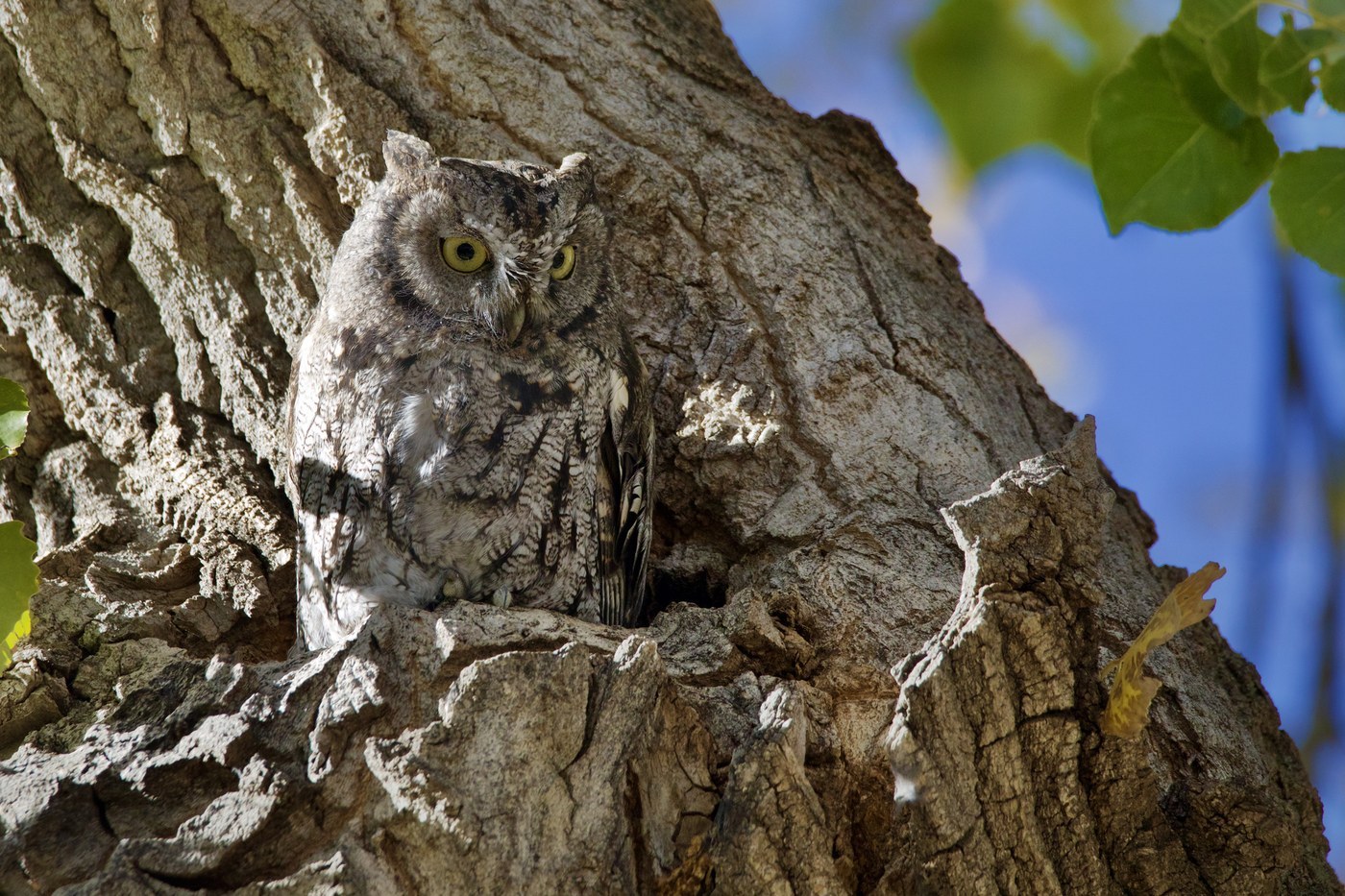
Western Screech-Owl
Megascops kennicottii
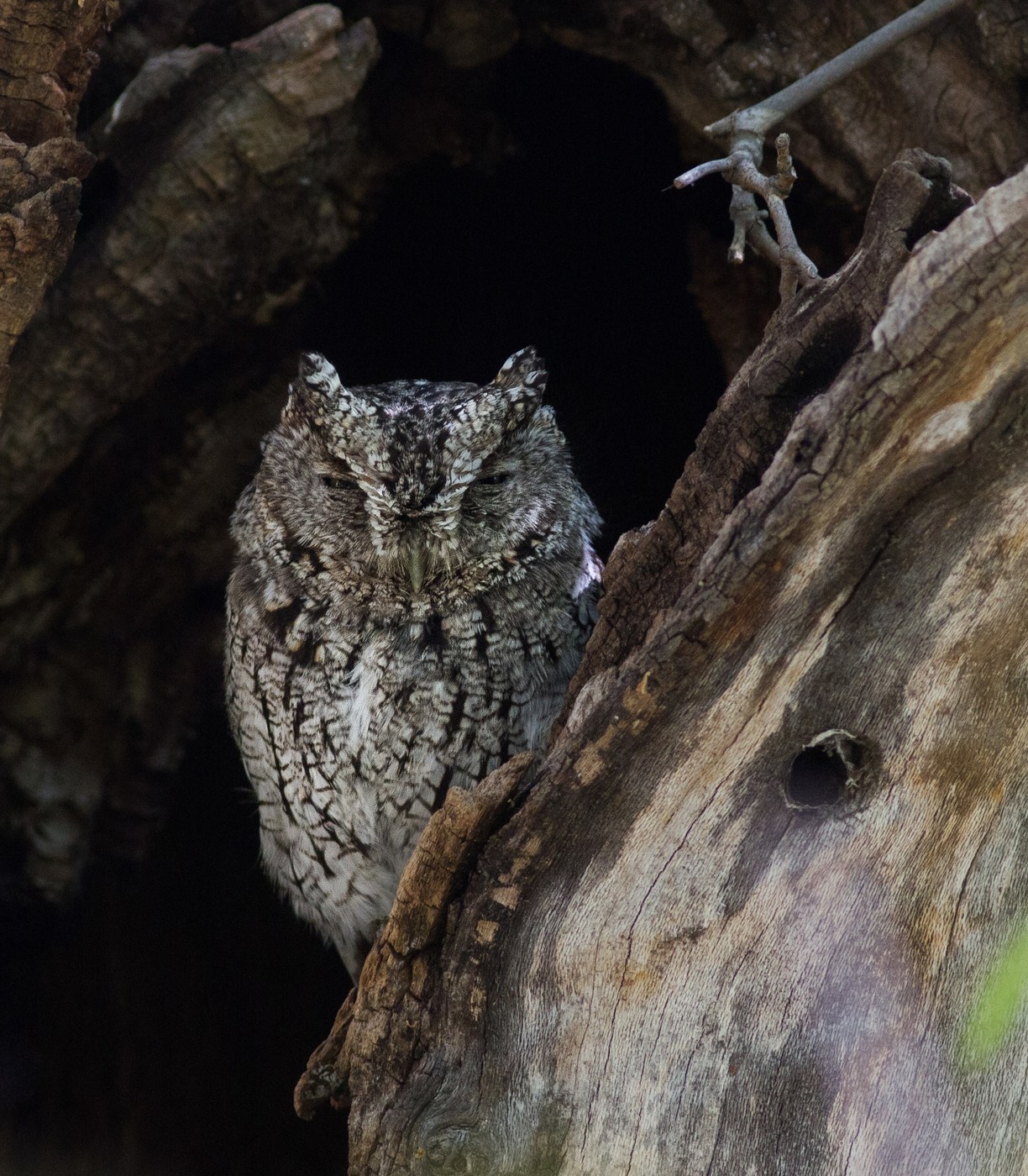
A small owl of western North America, closely resembling the Eastern Screech-Owl but occurring predominantly in a grey-brown morph, with finely patterned plumage suited to camouflage against bark.
- Feather type
- Small soft-fringed flight feathers; cryptic mottled/streaked body feathers; short ear tufts
- Colours
- Predominantly grey-brown with fine mottling and vertical streaking
- Bird size
- Small, ~19-25 cm
Found a feather like this?
Identify any feather from a photo, free.
Overview
The Western Screech-Owl replaces the Eastern Screech-Owl across much of western North America, occupying riparian woodland, desert washes with cottonwoods or saguaros, and wooded urban and suburban areas.
Unlike its eastern counterpart, it occurs predominantly in a single grey-brown morph, with the rufous morph common in the east being rare or largely absent here.
Its finely mottled, bark-patterned plumage and small ear tufts closely mirror the general Megascops screech-owl body plan, and it is best distinguished from relatives by range and voice rather than plumage alone.
Identifying the Feather
Recognizing the feathers
- Body feathers are grey-brown with fine mottling and vertical dark streaking, closely resembling bark texture.
- Ear-tuft feathers are short but present, as in other screech-owls.
- Flight feathers are small, soft-fringed, and scaled to this owl's compact size.
- Overall tone tends to be more uniformly grey-brown, with the bright rufous morph common in Eastern Screech-Owl being rare in this species.
Similar species
- Extremely similar to Eastern and Whiskered Screech-Owls; range (western North America) and the general lack of a rufous morph are the best clues distinguishing feathers of this species.
Plumage & Molt
Plumage
Adults are predominantly grey-brown with fine mottling and vertical streaking below; a rufous morph exists but is uncommon compared to Eastern Screech-Owl. Sexes look alike.
Juveniles show softer, more diffusely barred plumage before molting into the adult cryptic pattern.
Molt is gradual, occurring over the warmer months.
Habitat & Range
Habitat & range
Found across western North America from southern Alaska through the western United States and Mexico, in riparian corridors, desert washes with large cacti or cottonwoods, oak woodland, and wooded suburbs.
Largely non-migratory, holding stable territories year-round.
Behavior & Field Notes
Behavior & field notes
A nocturnal hunter of insects, small mammals, and other small prey, often hunting from low perches near water courses or woodland edges.
Its call is a distinctive accelerating series of hoots often likened to a bouncing ball, different from the whinny call of the Eastern Screech-Owl.
A small, grey-brown, finely mottled body feather with short ear tufts, found in western riparian or desert woodland habitat, is consistent with this species.
Frequently asked questions
How does this species differ from the Eastern Screech-Owl in plumage?
It occurs predominantly in a grey-brown morph, with the rufous morph common in Eastern Screech-Owl being rare here.
What habitat is typical for finding this species' feathers?
Riparian woodland, desert washes with large cacti, and wooded suburbs across western North America.
Does its call differ from the Eastern Screech-Owl?
Yes, its call is an accelerating series of hoots, distinct from the descending whinny of the Eastern Screech-Owl.
Is plumage alone enough to separate this from Whiskered Screech-Owl?
Not reliably - the two are very similar, and voice or range within areas of overlap is the more dependable distinguishing feature.
Western Screech-Owl guides
In-depth guides for identifying and understanding Western Screech-Owl.
Western Screech-Owl identified by the community
Real feathers identified with Feather Identifier.

Other feathers you may enjoy

Tawny Owl
Wing (flight) and body (contour) feathers
Little Owl
Wing and body feathers

Balsas Screech-Owl
Small ear-tuft feathers; soft, finely vermiculated body feathers

Blakiston's Fish Owl
Massive flight feathers with looser structure; shaggy body plumage; prominent ear-tuft feathers

Barn Owl
Wing and facial-disc feathers
Southern Boobook
Rounded flight feathers; banded tail; spotted body plumage

Sooty Owl
Broad soft-edged flight feathers; heart-shaped facial disc feathers; finely speckled body plumage

Short-eared Owl
Broad soft-fringed flight feathers; streaked body feathers; tiny, rarely visible ear tufts

Stygian Owl
Dark, mottled flight and body feathers with long, closely-set ear tufts
Whiskered Screech-Owl
Small soft-fringed flight feathers; finely mottled body feathers; short ear tufts

White-faced Scops Owl
Small to medium flight feathers with a distinctive whitish facial disc and long ear-tuft plumes

Verreaux's Eagle-Owl
Very large flight and tail feathers; dense soft body plumage; broad ear-tuft feathers